
AI decision rights are becoming an operating-model problem because agentic systems can multiply the volume of work, analysis and proposed action without multiplying the number of leaders available to decide what happens next.
In Germany, one of the most familiar distinctions between a small company and a large one is captured in two words: Entscheidungswege and Entscheidungsgeschwindigkeit: decision paths and decision speed. A small “speedboat” can often move because the people doing the work are close to the people allowed to decide. As organizations grow, information travels farther, more stakeholders need to be consulted, and more decisions move upward before anything consequential can happen. That does not make large organizations incompetent. It reflects an operating model built to coordinate scale, risk and accountability.
The trade-off becomes dangerous when execution capacity changes but decision capacity does not. AI can shorten the distance from an idea to analysis, from analysis to recommendation, and from recommendation to executable work. A product team can examine more evidence. Marketing can produce more variants. Operations can identify more exceptions. An agent can research, draft, compare, classify, calculate and prepare actions at machine speed. If every uncertain or consequential result still needs to travel through the same hierarchical approval path, the organization has accelerated everything before the bottleneck and left the bottleneck almost untouched.
AI does not have to break the hierarchy. It only has to multiply the pressure underneath it.
The Human Approval Bottleneck is an old organizational problem with a new multiplier
The Human Approval Bottleneck
The Human Approval Bottleneck appears when the volume of decisions, exceptions or actions requiring human authorization grows faster than the meaningful review capacity of the people authorized to approve them.
The failure is not simply slower work. Review quality, transparency and accountability begin to degrade as the queue grows.
This mechanism existed before generative AI. McKinsey’s work on decision velocity has repeatedly pointed to unclear decision rights, layers of governance and risk-avoidant oversight as causes of decision churn. In one public-sector example, efforts to build consensus created more than 70 governance bodies; the recommended response included clarifying decision rights and empowering decision owners to execute. Its broader work on delegated decision making makes the same point: explicit authority and accountability can move decisions closer to the work and reduce the delays created by repeated escalation. The decision-velocity research is worth reading precisely because it predates the current agentic-AI discussion.
The failure sequence is familiar. Leaders receive more requests than they can inspect carefully. They protect themselves by throttling delivery, adding gates, batching reviews or requiring more preparation before something reaches them. Alternatively, they approve more quickly. That can feel pragmatic: say yes, move, fail fast, fail cheap, but superficial approval is not the same thing as distributed judgment. It can create the theatre of control while weakening the quality of the decision.
Below that layer, teams become frustrated. Work waits. Initiative decays. Employees learn that local judgment is less important than navigating the approval path. High-agency people find workarounds or leave. Opportunities expire while the company aligns. Smaller competitors move on an initiative before the incumbent has finished deciding which forum owns it. The organization may still be productive, but its ability to convert ideas into accountable action becomes constrained by the throughput of its hierarchy.
AI changes the ratio. It can generate more research, more analyses, more options, more recommendations, more proposed actions and more exceptions before senior leaders acquire a single additional hour in the day. This is why AI is a challenge to the shape of the firm, not only another productivity technology. Many organizations were designed around cognition being scarce and slow. Once part of that scarcity weakens, the architecture that protected leadership attention can become the architecture that prevents the organization from using its new capacity.
The wrong response is to make leaders approve faster
When the queue becomes visible, the natural response is process optimization. Create a better dashboard. Summarize the recommendation. Reduce the approval meeting from sixty minutes to thirty. Let the agent prepare the decision memo. Add a confidence score. These interventions can help, but they leave the underlying assumption untouched: important judgment still belongs centrally, and the rest of the organization exists partly to prepare that judgment for leadership consumption.
That is not always wrong. Some authority should remain concentrated. Capital allocation, consequential people decisions, fiduciary obligations and strategic commitments can carry second- and third-order effects that are difficult to infer from immediate evidence. Decades of pattern recognition can tell an experienced leader that a locally attractive decision is likely to create a problem three iterations later. German corporate practice contains a useful analogy in Prokura: significant commercial authority is not casually distributed merely because empowerment is fashionable. It is earned and formally granted because consequence and accountability matter.
The answer, therefore, is not “flatten the hierarchy” or “delegate everything.” Harvard Business Review’s recent work on what companies get wrong about decision rights is useful here. It argues that decision-rights tools fail when organizations treat them as static assignments, misunderstand the roles or allow hierarchy to override the agreed decision process. Decision rights are a living operating mechanism, not a chart produced once during a transformation program.
That distinction becomes more important with AI. A human approval gate should exist because human judgment changes the outcome, not because the old workflow happened to contain a manager signature. Google Cloud’s current architecture guidance treats human-in-the-loop as a deliberate design pattern for critical actions, subjective judgment and situations requiring human oversight, not as a universal checkpoint for every agent action. The technical design already assumes that different classes of work require different control patterns. The operating model should do the same.
Good leaders have always tried to distribute judgment, not only tasks
The leadership analogy matters because organizations have faced this problem without AI for decades. Companies love to talk about their DNA and values. At their best, those ideas are a mechanism for distributing judgment: people understand enough of the company’s intent, priorities and boundaries to act without waiting for the founder or executive team to interpret every situation. At their worst, values are simply another top-down mandate: words that describe how employees should behave while decision authority remains concentrated elsewhere.
I experienced the positive version in a company I joined at roughly its hundredth employee. Colleagues still told stories about the early days when the founders came down on Friday afternoon with beers and celebrated the week directly with the team. That intimacy was no longer scalable. The more interesting question was how to preserve the useful part of it: shared context, ownership and a sense that employees had a stake in the business rather than simply a list of tasks.
OKRs became one mechanism for doing that. They were not perfect, but they helped make intent visible while allowing teams to decide how to contribute. The cultural message was equally important: leaders appreciated being consulted, but there was a strong bias toward asking forgiveness rather than permission. That only works when people understand the business well enough to exercise judgment. Empowerment without context is abandonment. Context without authority is theatre.
I have also seen the more protective version. In another organization, leaders were anything but authoritarian. They behaved more like father figures. They protected their teams, managed stakeholder communication and absorbed difficult decisions themselves. The intent was generous. The operating effect was less helpful: transparency declined because leaders became the reporting layer, and progress slowed because people who could have made decisions waited for the people who had learned to carry them.
We did not fix that with shock therapy. We introduced delegation gradually, using Delegation Poker to make uncomfortable assumptions discussable. The value was not the cards. It was the explicit conversation: for this class of decision, who decides today, who should decide later, what needs to be true before authority moves, and when does the leader still need to be consulted?
Management 3.0’s Delegation Poker model uses seven levels ranging from manager-led decisions through consultation and agreement to full delegation. Its Delegation Board places key decision areas vertically and the delegation spectrum horizontally. The framework can feel almost cliché in agile circles now, but the underlying design question has become newly relevant: authority is not binary, and it should be discussed at the level of a concrete decision rather than as an abstract promise to “empower teams.”
Agentic systems need the same conversation on a second axis
This is where I think Delegation Poker becomes interesting again. Human organizations already need to decide who should have authority over a workflow. Agentic organizations introduce a second question: how much authority should the AI have inside that same workflow?
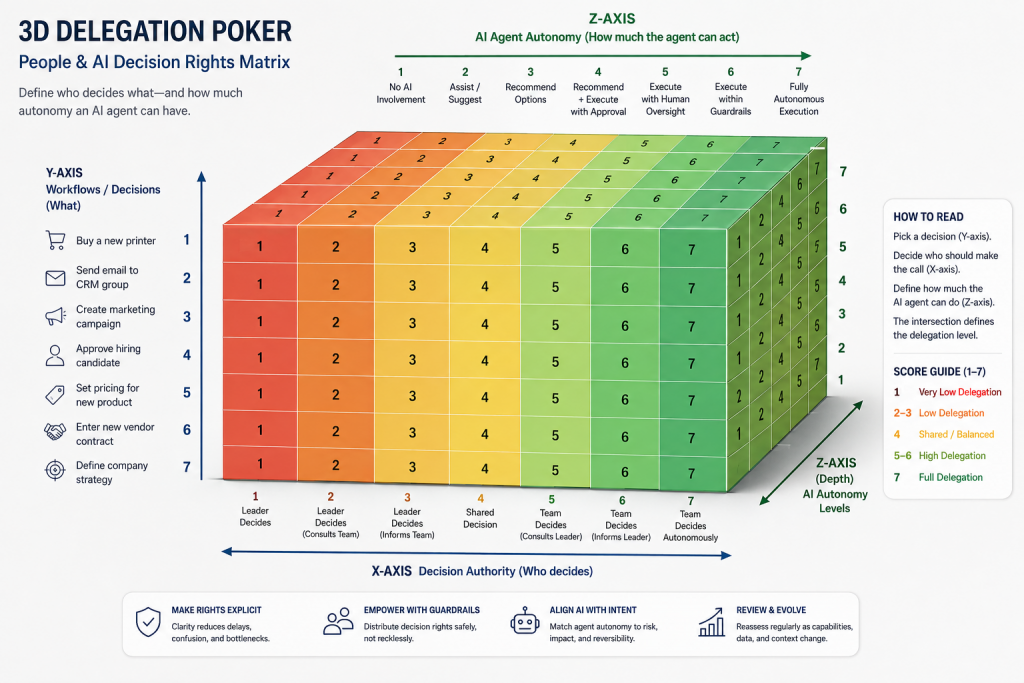
Take two mundane examples. Which printer should the office buy? Which email should be sent to which CRM segment? The human decision right might sit at different places in the organization. Procurement policy may centralize one decision while marketing ownership distributes the other. The agentic dimension is separate. An AI system might only research printer options, recommend one, prepare an order within a budget, or execute automatically under explicit constraints. In CRM, it might draft a campaign, recommend the segment, prepare the send, or be forbidden from sending without human approval because reputational consequences are higher.
I am beginning to think of this as a three-dimensional Delegation Board: workflows and recurring decisions on the vertical axis; the seven human delegation levels across one axis; and a second 1–7 scale for agentic authority extending outward from the board. It is an experiment, not a finished OSC framework. But the geometry makes an important point visible: human empowerment and agent autonomy are related without being identical.
A team can be highly empowered while its AI remains recommendation-only. An agent can have considerable bounded execution authority inside a workflow whose ultimate business decision remains with a senior leader. A decision can move outward in the human organization while agent authority temporarily moves back because evidence quality deteriorates or the consequences change. The right question is not “how autonomous is our AI?” It is “what combination of human decision rights and agent authority produces the best outcome for this class of work?”
Decision rights should be earned by demonstrated decision quality
This is the point where Thursday’s operating-model argument connects to the practical mechanism in AI Agent Decision Quality Improves When I Stop Writing Better Prompts. If an agent keeps escalating the same decision, the leader should not simply become faster at answering it. The more valuable question is whether the judgment behind the answer can be made legible enough to improve the system.
The person best qualified to do that is often the same leader currently creating the bottleneck. Senior leaders have accumulated the context, pattern recognition and consequence awareness that make certain decisions difficult to delegate. Their job is not to surrender that judgment. Their job is to convert as much of it as possible into usable principles, examples, guardrails, evaluation criteria and escalation conditions, then keep the irreducible remainder where human experience still changes the outcome.
Agent engineering is already converging on this lifecycle logic. Anthropic’s 2026 guidance on evaluating AI agents emphasizes turning failures and observed behavior into reusable evaluations rather than remaining in a reactive production loop. Evals do not solve organizational delegation, but they provide an important technical analogue: authority should expand because performance is demonstrated and observable, not because someone wrote a confident prompt once.
The same applies to people. A leader who repeatedly corrects an employee’s work without explaining the reasoning is not scaling leadership. They are preserving dependence. A leader who walks through the decision, makes the trade-offs explicit, defines what unusual looks like and then lets the person try again is developing judgment. Human development is richer because the employee contributes independent experience, motivation and perspective. The analogy should not erase that difference. But the operating principle travels surprisingly well.
Delegation changes decision rights. It does not remove leadership accountability.
The Human Premium is the reason not to maximize delegation
The most dangerous conclusion from this argument would be that more delegation is always better. It is not. “Modern ways of working” should not become a moral justification for moving authority outward when doing so damages the company. Decision design is outcome-led. A decision should remain centralized when centralization produces a better result for the organization as a whole.
This is where the Human Premium Enterprise becomes concrete. Human judgment and nuance matter most where experience changes how evidence is interpreted. A capital-allocation model can show an attractive immediate return while an experienced executive recognizes that the investment creates a dependency that becomes dangerous three cycles later. A people decision can look efficient on paper while a leader who has spent decades watching teams evolve notices signals that are absent from the dataset. A legal or fiduciary decision can carry accountability that the organization cannot delegate to software regardless of technical competence.
Human involvement should therefore become more selective and more valuable, not merely smaller. This is consistent with the accountability gap inside AI-enabled workflows: “human in the loop” is not an accountability model if the human is simply clicking approve without the time, information or authority required for meaningful review. The system needs to route judgment to the person who can actually change the outcome.
Leadership accountability remains intact even when decision rights move. Leaders are paid for more than having the final click. Their value includes setting boundaries, establishing guardrails, noticing downstream consequences, creating the environment in which others can exercise judgment and recognizing when the existing rules no longer fit reality. That is why the future of leadership is not diminished by distributed decision rights. Done well, it becomes more demanding.
Start with the ten decisions that still climb the hierarchy
An executive does not need a company-wide transformation program to test this thesis. Start with the ten recurring decisions that still move upward through the hierarchy. They may be approvals, exceptions, spending choices, customer commitments, staffing calls, content releases, pricing changes or routine operational judgments. The specific list matters less than the pattern.
For each decision, ask why it travels upward. Is the leader the only person with the necessary context? Does policy require authorization? Is the downside irreversible? Is accountability genuinely concentrated there? Or has the organization simply never invested in making the judgment transferable? Then ask the agentic question separately: what may AI observe, prepare, recommend, execute or escalate inside this workflow?
The AI decision-rights stress test
- List the recurring decisions: identify the ten decisions that most often escalate upward or wait for approval.
- Name the reason for centralization: distinguish real accountability, consequence and expertise from inherited habit.
- Make human decision rights explicit: state who decides, who advises, who must be consulted and who is informed.
- Define agent authority separately: decide whether AI observes, recommends, prepares, executes within bounds or must not act.
- Set the learning path: define what evidence would justify expanding or reducing either human delegation or agent authority.
- Keep accountability visible: record which leader remains responsible for boundaries, outcomes and redesign when the pattern changes.
This is not very different from good organizational design before AI. What changes is the urgency. HBR’s current decision-rights research argues for clarifying the decision itself, co-creating roles and revisiting assignments rather than allowing hierarchy to silently reclaim authority. Agentic systems add another actor to that conversation. If companies do not make the rights explicit, AI will not magically infer the governance model leaders intended. It will operate inside the one the organization actually built.
The resulting operating model is socio-technical. The next AI bottleneck is not the tool; it is the operating model. Technical controls matter: permissions, deterministic constraints, logs, evaluations, monitoring and escalation mechanisms. Organizational controls matter just as much: clear objectives, decision ownership, capability development, incentives, transparency and an explicit understanding of where human judgment earns its place.
Your current operating model cannot simply absorb agentic AI
This is the belief I think executives need to challenge most directly. AI is not an additional source of capacity that can simply be poured into the existing organization while decision architecture remains unchanged. If the company retains every old approval path, reporting layer and escalation habit, the new capacity will encounter the old bottlenecks faster and more often.
The first symptoms may look manageable: more meetings, more notifications, more approval requests, more “quick questions” for senior people. Then the adaptations begin. Leaders throttle initiatives because their queue is full. Teams learn which approvals are ceremonial. People stop surfacing exceptions because escalation is expensive. AI-generated options pile up faster than anyone can meaningfully distinguish them. The organization appears busy while decision quality deteriorates.
The alternative is not autonomous chaos. It is a deliberate architecture of distributed judgment. Leaders make decision rights explicit. Employees are put on a path to earn more authority through context, capability and outcomes. Agents receive bounded authority that expands only when their decision quality is demonstrated. High-consequence decisions remain human-led where accumulated experience, accountability and nuance justify the premium.
That is a much harder transformation than installing agents. It changes what leadership attention is for. It changes how values become operating principles. It changes how teams earn trust. It changes how governance distinguishes a meaningful human judgment gate from an inherited signature. And it asks executives to confront a possibility that is easy to avoid while AI remains a pilot: the organization may be technologically capable of far more action than its hierarchy is capable of absorbing.
The AI-native organization will not scale by removing leadership. It will scale by making leadership judgment less dependent on leadership presence.
The most practical place to begin is still the least glamorous: write down the ten decisions that repeatedly climb your hierarchy. Then ask which ones genuinely require the person at the top and which ones are only there because nobody has yet done the leadership work required to let better decisions happen without them.


