Agentic companies will not be managed by tasks. They will be guided by objectives.
I wrote that line down because it captured something I have been feeling more than theorizing. It came from working with AI agents, but it also took me back to something I have always appreciated more than most people seem to: OKRs.
Not because OKRs are perfect. They are not.
Not because they magically make strategy clearer. They do not.
Not because every organization that adopts them suddenly becomes focused, aligned, and accountable. Anyone who has lived through a bad OKR cycle knows how quickly the ritual can become theater.
I have appreciated OKRs because, when they work, they make conversations about shared purpose easier.
As a team member, they helped me understand what my work was moving. As a leader, they helped me discuss direction, evidence, and tradeoffs instead of only activity. They created a language for contribution that was not limited to rank, proximity to clients, or ownership of an obvious revenue number.
That is why they suddenly look different to me in an agentic workflow.
Tasks tell an agent what to do. Objectives tell a human-agent system what outcome to move toward. Key Results provide evidence that the work is actually moving.
That distinction becomes much more important when the work is no longer just executed by people receiving instructions, but by people coordinating agents that can interpret context, call tools, generate outputs, and pass work through probabilistic workflow chains.
The old management instinct is to respond to that with more tasks, tighter checklists, and more approvals.
I understand the instinct. I do not think it scales.
Task Management Made Sense In More Deterministic Systems
There is a reason task management became the default language of work.
For many kinds of work, it is useful. Define the requirement. Assign the task. Execute the instruction. Check completion. Move the card. Close the ticket.
That control model works best when the work is reasonably deterministic. If the input is clear, the desired output is well understood, and the path from one to the other is stable, then task management is not only efficient. It is humane. Nobody needs a philosophy seminar for every piece of work.
But knowledge work has never been fully deterministic. It only pretended to be more often than it should have.
A lot of professional work looks task-shaped from the outside and purpose-shaped from the inside. Write the deck. Build the model. Draft the proposal. Prepare the workshop. Summarize the meeting. Create the dashboard. Review the market. Those sound like tasks, but the value rarely comes from completion alone.
The value comes from whether the work moves something that matters.
Does the deck clarify a decision? Does the model make a tradeoff visible? Does the proposal increase trust? Does the workshop create momentum? Does the dashboard make a weak signal easier to detect? Does the market review change what the company should do next? In a recent conversation with a friend, he said his boss’s reaction to every awesome idea an employee has is: is there a real problem you will solve with this?
If the answer is no, then the task can be complete and still be useless.
AI makes this problem sharper because agents are very good at producing task-shaped progress. They can generate documents, synthesize notes, create variants, inspect pages, structure arguments, rewrite drafts, and move information from one format into another. The output can look finished. The chain can look active. The dashboard can show movement.
But movement is not the same as progress.
This is where objectives start to matter more, not less.
Agentic Work Changes The Control Model
The more agentic a workflow becomes, the less useful it is to manage every step as if it were a small deterministic task.
An AI agent does not simply receive a task in the same way a traditional system receives an instruction. It interprets the prompt. It reasons over context. It chooses a path. It may call tools. It may retrieve information. It may generate an artifact. It may hand work to another process. It may summarize its own state badly. It may produce something superficially polished while missing the deeper point.
That does not make agents bad or uncontrollable. It means the control model has to change.
Anthropic has written about this distinction in its work on building effective agents, separating predictable workflows from agents that dynamically direct their own processes and tool use. More recently, its research on measuring agent autonomy argues that effective oversight is not just a human approval step. As users gain experience, they often move from approving every action toward monitoring what the agent does and intervening when needed.
That feels right from practice.
When an agent is doing a small bounded task, task-level control is fine. Find broken links. Format this excerpt. Create a slug. Summarize this source. Extract the post metadata.
But when agents participate in a broader workflow, the question changes. The human is no longer only checking whether a task was completed. The human is judging whether the system is moving toward the right outcome.
That requires objectives.
It also requires constraints. More on that later.
Microsoft’s 2025 Work Trend Index described the rise of human-agent teams and the so-called Frontier Firm. I do not think every organization needs to adopt Microsoft’s vocabulary. But the underlying point is hard to ignore: companies are beginning to imagine work as something performed by hybrid teams of humans and agents.
If that is where work is going, then task management alone is too small a language.
A task can tell an agent what to produce. It cannot, by itself, tell the human-agent system what contribution should matter.
Why I Have Always Liked OKRs More Than Most People
My appreciation for OKRs came from a very practical place.
I joined a company that had set as its primary Objective to move from being an interesting niche professional services company for Design Thinking work toward more long-term engagements. That was the strategic direction. But I was new. I had just left a SaaS Head of Product role for consulting, and I did not yet have a client network inside the firm.
If the goal had been framed only as gaining a certain percentage of recurring revenue, I could have understood it intellectually without having a meaningful way to contribute immediately. I did not have the relationships. I did not own the accounts. I could not simply go to existing clients and create recurring revenue from nowhere.
But the Objective was different: move toward long-term engagements.
That gave me room to contribute.
I started thinking about what evidence could validate that direction. What would show whether the work was creating conditions for re-engagement? What signals could colleagues capture with their clients? What aspects of the service portfolio could be improved through small innovations that made future engagement more likely?
So I created a real-time dashboard and surveying mechanism that colleagues could use with their clients. It was not my revenue number. It was not my client relationship. But it gave the company a way to observe and improve the conditions that could lead to long-term work.
The Objective gave my work purpose.
That is the part people often miss when they dismiss OKRs as management fashion. A good objective is not just a prettier goal. It opens contribution. It gives people a way to connect their judgment, skill, and local context to a shared outcome.
The public definition of OKRs from What Matters describes them as a collaborative goal-setting methodology for setting ambitious goals with measurable results. I like the word collaborative there. The best OKRs are not just a leadership broadcast. They are an invitation to ask, from wherever you sit: how can I move this outcome?
That is why they fit agentic work better than I initially expected.
Bad OKRs Are Usually Blamed For Bad Management
Of course, OKRs often fail.
The most common complaint is simple: they do not work.
I think that complaint usually hides two different problems.
The first is that OKRs are treated as normal goals with a new label. A financial target gets rewritten as an objective. A list of activities gets rewritten as key results. The language changes, but the operating logic stays the same.
The second is that OKRs are used as a leadership communication tool instead of a contribution system. Leadership has a bad period. Leadership decides it needs to do things differently. Leadership introduces OKRs. Leadership explains the mission. Then, after another unsuccessful period, the OKRs get blamed. You should question your OKRs before you question the methodology.
That is like blaming a Ferrari for not being fast when you do not know how to drive stick.
The tool may be wrong for the situation. The implementation may be weak. The organization may not have the discipline, skill, or trust needed to use it well. But the deeper failure is usually not that objectives and evidence are bad ideas.
The failure is that the organization never changed how contribution, autonomy, and learning actually worked.
This matters for agents because the same mistake is already visible.
Companies will buy agents. They will assign them tasks. They will wire them into workflows. They will complain that the outputs need supervision. They will blame the agents for not being autonomous enough or reliable enough. Some of those complaints will be valid.
But some of them will be mirrors.
The fact that, potentially, the biggest complaint you might have of implementing agentic work in your enterprise is that it needs human supervision, might be a testament to the fact that your company believes that good work is only being done if the employee has someone looking over their shoulder constantly.
That is an uncomfortable thought.
If the organization already equates supervision with control, and control with task inspection, then agentic work will feel threatening. Not because agents are impossible to govern, but because the company has never learned how to manage autonomy well in the first place.
I Run Open Source Consulting With Agents, And The Task Model Broke Quickly
I should be very direct about this: I use AI.
Open Source Consulting is not a thought experiment about agentic work. The operation is already supported by agents.
At the moment, I have four agents helping maintain the website and content system. One supports the general architecture. Others support weekly strategic planning, article generation, and executive-level briefings. They help explore topics, challenge whether an angle is too generic, adapt a core idea into MICRO, MACRO, briefing, newsletter, and LinkedIn formats, and preserve continuity across themes like the Human Premium Enterprise, the Cognitive Revolution, Interface Tax, Trust Tax, and AI adoption.
That does not mean the agents decide what matters.
They do not.
I define the objective, the constraints, the quality bar, and the final judgment. I supervise. I veto. I decide whether an output adds value or merely looks complete.
But the interesting part is what happened when I initially worked with them mainly through tasks and identities.
Each agent had a role. Each had a defined responsibility. On paper, that sounded clean. In practice, it created overhead. I had to approve how information moved between them. They frequently contradicted purpose because I had assigned identities that did not always overlap. One agent would optimize for a local deliverable while another optimized for a different interpretation of the system.
The coordination burden moved back to me.
The turning point came when the agents started orienting around shared objectives measured by the same analytics. They did not suddenly become one voice. I would not want that anyway. But the contradictions changed. Instead of constantly requiring purpose-level correction, the workflow needed fewer adjustments because the agents were trying to move the same outcomes.
That is the practical difference between tasking agents and guiding a human-agent system.
Tasks produced local completion.
Objectives improved system coherence.
The distinction is not abstract for me anymore. It is the difference between spending my attention on handoff policing and spending it on judgment.
Objectives Are Not The Same As Constraints
There is a risk in this argument, so I want to make the boundary clear.
Objective-guided autonomy does not mean letting agents do whatever they want. It does not mean abandoning specificity. It does not mean replacing workflows with vibes.
Some things absolutely need constraints.
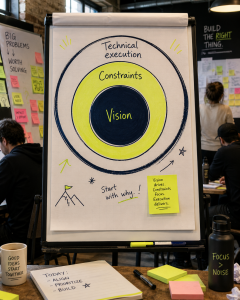
If a result has to be a specific file type so another agent can continue the workflow, that is a constraint. If a draft must use a specific category, that is a constraint. If a WordPress post needs metadata in a particular format, that is a constraint. If an image must be landscape, photorealistic, and contain no text, that is a constraint.
Constraints are not micromanagement. They are the negotiated boundaries that make autonomy useful.
This reminds me of a simplified model from agile product work. In that model, there are three circles. The inner circle is the product vision, which belongs primarily to the Product Owner. The outer circle contains technical specifications, such as database choice or programming language version, which belong primarily to the engineering team. The middle circle contains constraints, which should be negotiated and co-created between product and engineering.
That same logic applies to agents.
The human sets direction. The agent handles work within the space where it can operate productively. The constraints are established, tested, and iterated through collaboration.

I suspect this will become more important as agentic workflows mature. We may need the equivalent of Delegation Poker for agents: a practical way to decide which decisions are human-owned, which are agent-owned, and which sit in the middle as negotiated constraints.
That is not because agents are people. It is because autonomy without negotiated boundaries creates coordination problems, whether the collaborator is human or machine.
The better question is not: should agents be autonomous?
The better question is: where does autonomy improve progress toward the objective, and where does it increase risk, ambiguity, or waste?
Key Results Matter Because Activity Can Lie
Objectives without evidence become slogans.
This is another reason OKRs map well to agentic work. Agents can create a lot of activity. They can produce drafts, summaries, variants, plans, recommendations, metadata, and handoffs at a pace that makes the system feel productive.
But activity can lie.
A content system can publish more while becoming less useful. A strategy workflow can generate more analysis while producing less clarity. A website can become intellectually cleaner while doing nothing for career optionality, executive authority, or commercial validation. A multi-agent system can look busy while simply moving words between containers.
Key Results are the pressure against that illusion.
They ask whether the work is actually moving.
For Open Source Consulting, that means the agents cannot only optimize for publication volume. The shared objectives have to connect to evidence: executive authority, returning visitors, profile views, meaningful conversations, AI-native professional-services validation, and the career pipeline. The analytics are not perfect. Search data is especially messy during a domain migration. But the principle matters.
The system needs evidence that the work is doing more than existing.
That is why objectives, constraints, and Key Results belong together.
Objectives define direction. Constraints define the operating space. Key Results define evidence of progress. Human judgment decides whether the evidence is real, whether the tradeoffs are acceptable, and whether the system is still pursuing something worth pursuing.
That last part does not disappear.
It becomes more important.
The same pattern sits behind the larger AI operating model question. Native AI does not only make people faster. It changes what the organization has to coordinate, measure, and trust.
The Human Premium Is Judgment, Not Supervision Theater
This is where the Human Premium Enterprise enters the conversation.
The human premium is not that humans can produce every artifact better than agents. That was never going to be the durable argument.
The human premium is deciding what matters. Setting direction. Defining constraints. Judging tradeoffs. Recognizing quality. Understanding context. Knowing when progress is real. Knowing when a beautifully completed task did not move the objective at all.
That is a different kind of work from task supervision.
Supervision theater is when a person sits above the workflow checking whether activity happened. Judgment is when a person understands the outcome deeply enough to decide whether the activity was worth anything.
Agentic work will expose the difference.
A company that only knows how to manage tasks will respond to agents by creating longer task lists, heavier approval chains, and more elaborate checklists. It will try to make probabilistic work behave like deterministic work. It may improve local reliability while killing the very autonomy that made the agents useful.
A company that knows how to manage objectives will behave differently. It will define the outcome. It will negotiate constraints. It will measure progress. It will create room for local judgment. It will expect human oversight, but it will aim that oversight at value, not merely completion.
That is a much higher standard for leaders.
It is also a much higher standard for employees.
In an agentic company, the human contribution becomes less about receiving tasks and more about shaping outcomes. People will need to understand objectives well enough to decide how to contribute. They will need to understand constraints well enough to protect the system. They will need to understand evidence well enough to avoid confusing activity with progress.
That is not anti-AI.
It is the opposite. It is what serious AI adoption requires.
Agentic Companies Need Objectives, Not Longer Task Lists
I do not believe OKRs solve agent governance by themselves.
That would be far too neat.
OKRs can become theater. Agents can follow the wrong objective. Metrics can distort behavior. Constraints can be too loose or too rigid. Human judgment can be weak, biased, or overconfident. A shared objective can improve coherence while still pointing the whole system in the wrong direction.
So the argument is not that OKRs are magic.
The argument is that agentic work exposes why task management was never enough.
When work becomes more autonomous, agentic companies need a clearer answer to three questions.
- What outcome are we moving toward?
- What boundaries make autonomy useful rather than dangerous?
- What evidence tells us whether progress is real?
Those are OKR-shaped questions, even if a company does not use the OKR label.
For me, the lesson has become personal and practical. I used to value OKRs because they helped me see how my work could contribute to a larger direction. Now I value the same logic because it helps me coordinate agents without drowning in local task management.
The pattern is the same.
People and agents both need more than tasks if the work is supposed to matter.
The Human Premium Enterprise will not be built by giving humans and agents longer task lists. It will be built by defining better objectives, clearer constraints, and stronger evidence of progress.
That is where the human work moves.
Not away from responsibility.
Toward the responsibility that matters most.